What If Being Right Isn't the Point?
I think a lot about how easy it is to confuse being “right” with actually making a difference.
For those of us working in caring professions, this can come up quite often. We see a problem that needs to be addressed. We have strong feelings about how. We’ve probably put years into understanding it and we’ve almost certainly watched people be hurt because of it.
We care deeply about issues and problems all around us.
But then we encounter someone who doesn't see it the way we do – and we have a dilemna, whether or not we actually name it:
How do we talk to people we disagree with without turning every conversation into a battle?
If you’re like me, the temptation in these moments is to explain more, find the best arguments possible, correct misinformation, point out contradictions, say the thing that will lead the person to have that “ah-ha” perspective-changing moment.
And if you’re like me, this almost never works – it just leads to more frustration, more fraying of relationships, and more unproductive disagreements.
Three Types of Polarization
In her book I Never Thought of It That Way, Mónica Guzmán breaks down what we usually refer to as “polarization” into three distinct types:
Ideological polarization
Affective polarization
Perceived, or false, polarization
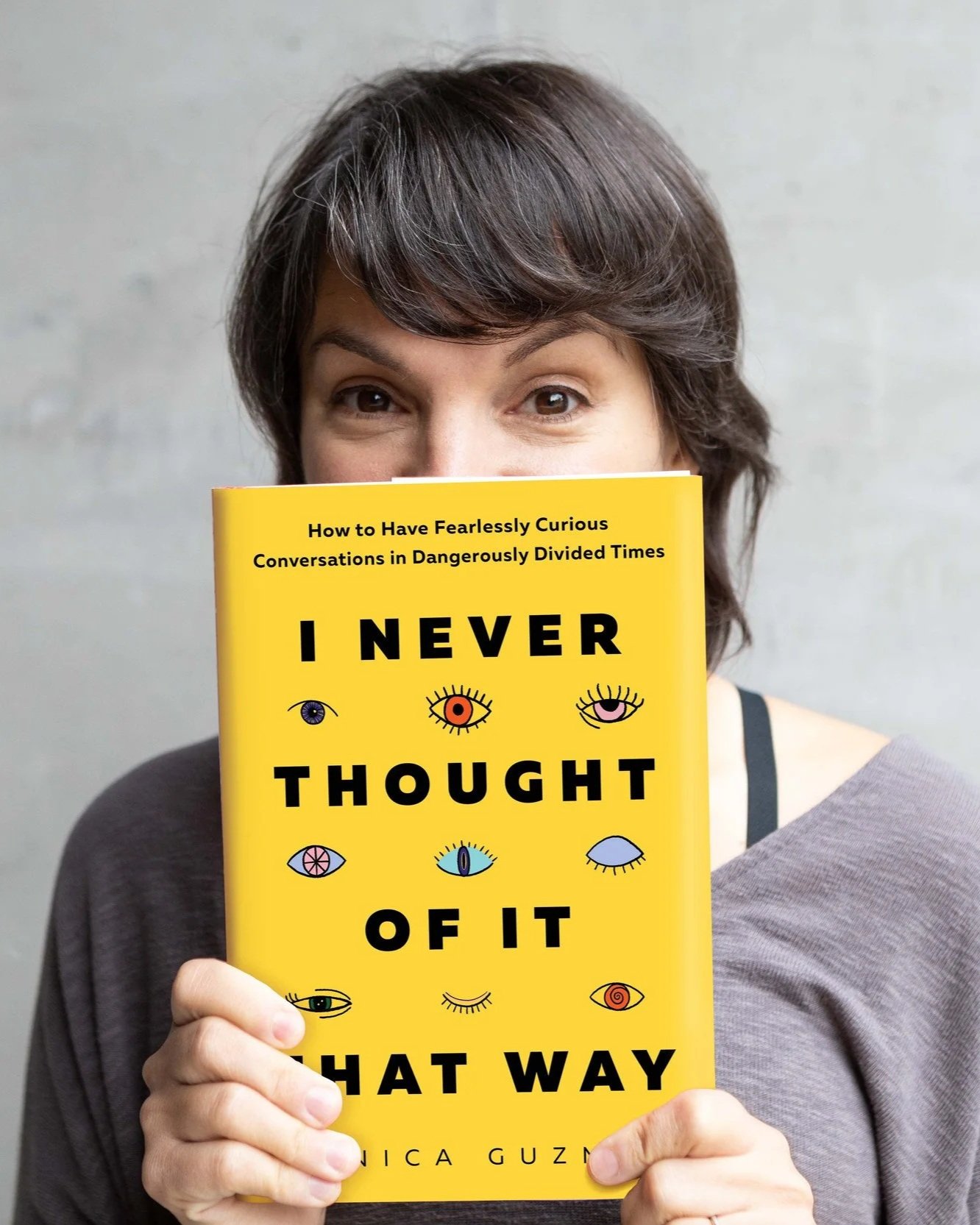
Image Credit: Mónica Guzmán
Ideological polarization is about actual disagreements over ideas and policies. When we are ideologically polarized, we disagree with each other on the merits of the “how.” We have different ideas and different approaches to fixing the problems right in front of us.
Affective polarization is about the animosity that develops between groups. This isn’t about policies or ideas or the problems in front of us at all; this is about us. When we are affectively polarized, we just don’t like each other. While it may have started because we see the world differently, we’re now polarized into groups because “that other group is bad.”
Perceived polarization is what happens when we think we’re a lot more different than we actually are.
For me, this last one is the most important. Because when we believe that someone with a different opinion and set of life experiences is way more different from me than they actually are, our internal safety mechanisms kick in. We choose to not approach or engage with them; we start seeing them as too different from us to be understood; we might even begin seeing them as less than us.
And once we’ve gotten to that point, any chance for respectful, honest relationship is pretty hard to get to.
The problem with winning
There are times when being right matters.
Sometimes a claim is simply false; sometimes it causes harm. And if you work in a caring profession or spend time organizing for social change, there are plenty of situations where “let's all just understand each other and get along” isn't an adequate response.
In these moments, it’s important that we take a stand. (And not in a performative way.)
But there is a difference between taking a stand for what we think is right and trying to “win” for what we think is right.
When we take a stand, we can exist in complicated and complex situations and the relationship between us and others can survive the strain of disagreement. When we try to “win,” the relationship is not only unlikely to survive, but the fallout is much more likely to be cause further harm.
Here are some examples of when it’s important to take a stand for what we believe is right, without trying to “win” anything:
A teacher needing to work with a parent who sees a situation very differently.
A nurse caring for a patient whose beliefs or choices frustrate them.
An activist building a coalition among people who agree on the broad goal but disagree about almost everything else.
A therapist hearing perspectives that challenge their own assumptions about what someone needs.
In each of these situations, being “right” is well and good. But trying to “win” and prove our rightness almost always gets in the way of us making the difference we actually want to make.
Talking about online disagreements, Guzmán includes a line from Elizabeth G. Saunders that gets very much to this point – and I think has parallels in off-line relationships as well:
“When you feel you won online, you've rarely changed anyone's mind.”
When we feel like we’ve “won,” we really need to check and see if we’ve actually moved closer or further from our goals.
What happens when we get curious instead?
As part of my day job, I train a team of instructional coaches whose job it is to work with teachers to shift from traditional forms of teaching (think: students in rows regurgitating facts and figures) to more hands-on, problem-based learning, grounded in what students care about.
And with all the pressure teachers are under right now, it is deeply challenging work.
But we’ve found one thing makes this kind of radical shift possible: asking good questions at the right times.
And this skill obviously extends well beyond the education and caring industry worlds.
When we ask good questions, bridges are built between people, conflict becomes grounded in curiosity rather than competing certainties, and new futures are (hopefully) made possible.
And vitally for our own mental health and relationships: learning to ask good questions can help us stay engaged with folks without feeling like we’re constantly in a battle.
None of us are born able to do this well; it’s a skill we develop through practice, messing up, trying again, and getting feedback – both positive and negative – from others.
So how do we ask these kinds of questions?
Guzmán has a nice little acronym I’ve found useful (meaning it sticks in my head when I need it most): CARE. She says these are questions we offer to others that are:
Curious — Driven by a genuine desire to understand another’s perspective, rather than to prove something we already believe.
Answerable — Something the other person can explore from their own experience or current knowledge, without immediate research or additional resources.
Raw — Stripped of the assumptions, judgments, or conclusions we may have already attached to it.
Exploring — open-ended, rather than leading someone toward a particular answer or conclusion.
Here are a few examples of good questions:
What concerns you most about _______?
What has helped shape your opinion on this?
When you say _______, can you say more about what you mean?
And here are a few non-examples:
“How could you possibly think Trump is doing the right thing on this?!”
“Wouldn’t you agree my way is better for everyone?”
“Don’t you think that’s a bit naïve?”
In the first ones, you can see curiosity, the questions are answerable without research, they’re raw enough to feel real, and they explore a topic or a difference rather than try to shut it down or put someone on the defensive. They might not lead to immediate “ah-has” (change often takes longer than we want), but they do center our common humanity – and that is in itself a radical act.
In the second ones, well – none of this is really there. They are accusatory, leading, and filled with emotion in a way that doesn’t exactly open up the conversation.
Each of them is a statement wearing a question mark.
And to be fair, I ask terrible questions all the time. I get frustrated and ask leading questions, attempt to “win” arguments, and default into a much more oppositional space than an exploring one. I fall into the trap of asking my kids the same boring “how was school today” questions everyday, despite knowing better questions to ask.
But that’s why this is a skill we build and not something we’re just immediately perfect at.
Guzmán has a great line that has stuck with me:
“Fail to notice your assumptions and they might harden into lies. Turn them into questions and they'll get you closer to truth.”
We don’t need to eliminate our assumptions and judgments – that’s probably not possible. But we can notice them before they damage our relationships. We can instead ask questions.
If I have a story in my head about why someone thinks the way they do, I can pause and ask myself:
What am I assuming here?
And then:
What would I actually like to know?
This not only opens up the conversational space between another person and me – it helps me become more aware of my own inner, unexamined, often-unquestioned thoughts and ideas.
Maybe we need to practice on shorter bridges
In her book, Guzmán recounts a story from John Powell, who talks about building “short bridges” and “long bridges” between people.
Short bridges connect us with people we already have a baseline understanding and respect for. These are useful with friends or acquaintances who just have different perspectives from us. We haven’t polarized extensively from each other; we just see the world a bit differently.
Long bridges, on the other hand, are the ones we can construct with folks who are significantly different from us. Perhaps it’s you and your MAGA father-in-law or your boss who feels it’s okay to say deeply problematic things in every staff meeting without accepting feedback.
Building short bridges is way easier than building long ones.
And yet, we sometimes talk about bridging political and social divides as if we should immediately be capable of having thoughtful, compassionate conversations with the people we find most difficult to understand.
Even worse, there are people who sometimes expect us to be able to have these conversations with others who are actively causing harm to us and those closest to us.
Both of those are pretty high – and potentially unhealthy – bars.
Instead, we can focus on building short bridges:
Talk to someone whose experience is different from yours but whose humanity you can already see.
Ask a CARE question of a friend you genuinely don't know the answer to.
Notice when you've made an assumption and apologize for it.
Stay in a conversation a little longer than you normally would.
And over time, by building these short bridges, we each become more and more capable of building longer bridges.
For those of us working as caring professionals, I think this is really important:
Many of us entered this work because we wanted to help. But our desire to “help” can quickly become a tendency toward saviorism, paternalism, control, and frustration.
“We know what people need! We know what the problem is! We know what would make things better! Now why aren’t they listening to me?!”
In these moments, we let certainty and the difficulty of building bridges – short or long – get in the way of understanding the people standing and moving right in front of us.
To make the difference we want to make in the world, we need a different posture.
A different posture in conversation
At this point, I’ve shared several frameworks from I Never Thought of it That Way, so here’s a quick summary:
In each of our lives, we interact with several forms of polarization: ideological, affective, and perceived. Instead of trying to be “right” all the time or “win” conversations with folks who are different from us, to overcome the growth of this polarization, we need to get curious. We need to ask questions – specifically CARE questions: Curious, Answerable, Raw, Exploring questions. This is how we begin to build short bridges and long bridges between us and others, creating communities of resilience and honest communication.
At its core, the invitation I take from Gúzman’s work is for us to be more intentional and aware of what each of us is doing in our conversations.
We can listen with less certainty and more curiosity; question with less assumptions and judgments; stand for what we believe in with less rigidity that we must win.
And that over time, this kind of posture shift leads our communities to becoming healthier, and possibly even happier, places in which to live our lives.
📬 Share this with your people:
