Self-Care and Community Care: Reflecting on How We Sustain Ourselves For the Long Haul
Last week, I shared that back when I was a teacher, I had a “let-it-go bridge” – and once I crossed it at the end of the day, I committed to transitioning out of work-mode.
It was a boundary I set as an act of self-care – and because I did, I was a lot less grumpy in the evenings and able to be a lot more present with those around me.
When we spend a lot of our time caring for others – whether professionally or personally – it’s vital we create these types of rhythms of self- and community care.
And this is especially important for people whose work involves caring for others. Teachers, nurses, therapists, social workers, and nonprofit workers can spend so much of their time responding to other people's needs that their own well-being starts to feel like something they'll get to later.
And even when we do make time for ourselves, we don't always make enough room for the relationships and shared practices that help us sustain each other.
We need both practices of both self-care and community care:
Self-care: Consistent, individual practices that support our well-being and build our capacity to engage further with our communities and our world. These practices always make an impact beyond us, directly and indirectly.
If an activity primarily provides comfort without helping us build our capacity to navigate the muck of life, it’s worth questioning whether it’s helping us to rest and recover or if it’s serving to help us avoid or ignore something difficult. (Which can still feel supportive short-term, but is not as helpful for individuals or communities in the long-term.)
Community care: Consistent practices that honor the well-being of the community, help to deepen relationships, materially support each other, and build communal resilience.
When we engage in community care, people trust that others will show up for them and they feel emboldened themselves to show up for others. Acts of community care create group cultures that reject individualism and dehumanization, instead focusing on celebrating life together and collectively solving problems that interfere with that.
The distinction isn't between caring for yourself and caring for other people. It's between practices that support our individual capacity to engage with life and practices that help us build the relationships and shared capacity to meet life together.
And without intentionally considering how we are engaging in both, it can be easy to default to what our culture incentivizes:
Burning ourselves out caring for others while engaging in practices that solely provide comfort, rather than help build our capacities for personal and communal resilience.
That’s not great!
So this week, I invite you to consider how self-care and community care shows up in your life.
How to Practice Self-Care and Community Care
Below is The Self- and Community Care Wheel, originally offered by activist and social worker Farzana Doctor, to help you identify the activities you’re engaging with in an active and consistent way.
Here’s an abbreviated version of mine:
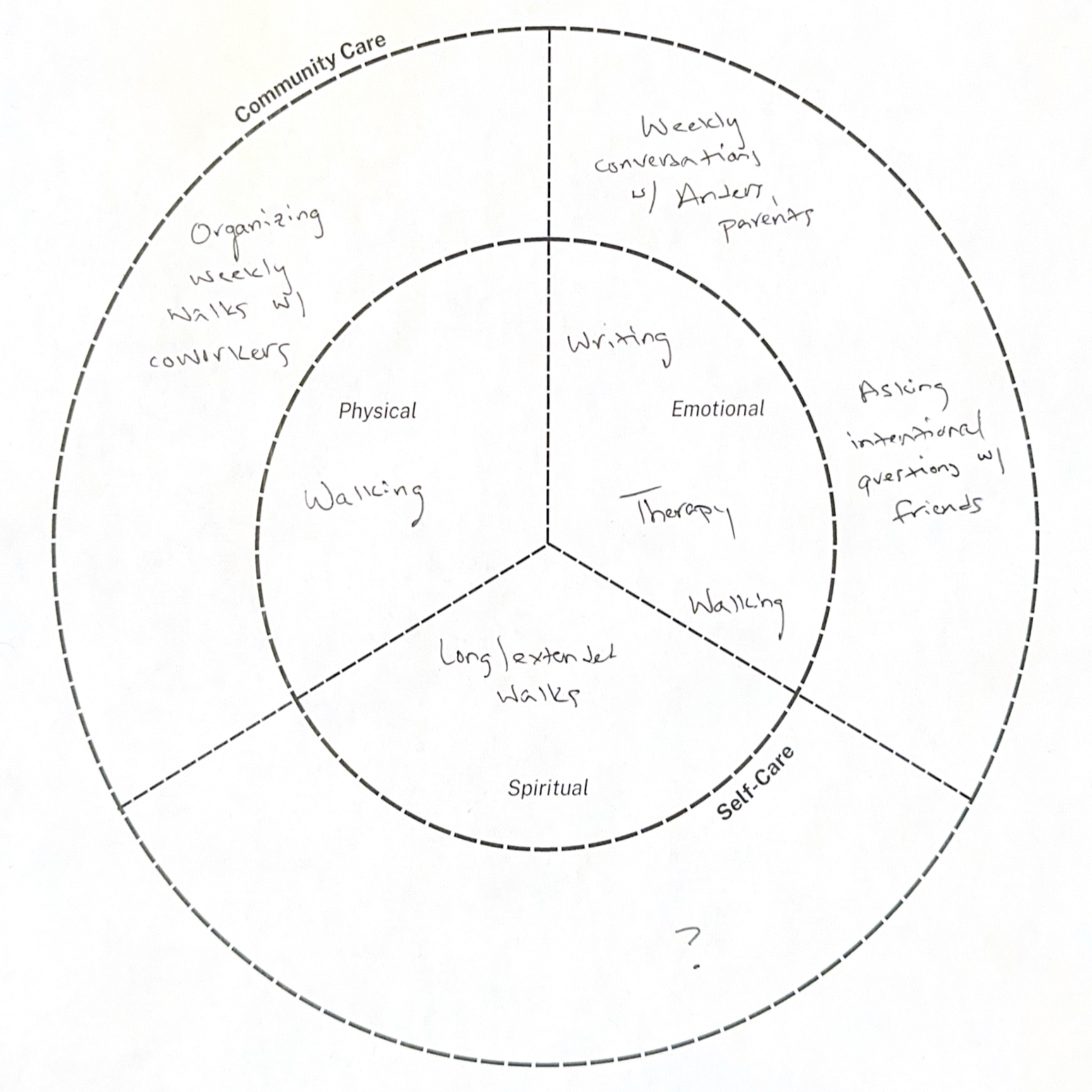
As you can see, walking is a big part of how I show up in the world, alone and with others. (And if you ask my partner, she’ll tell you: she knows when I haven’t walked in a bit! The quality of my self-care has a direct impact on how I show up with others.)
👉 Download the Self- and Community Care Wheel for yourself. (Or you can draw one in a notebook or on a piece of paper!)
As you fill out your wheel, here are some questions to reflect with:
What practices are sustaining me?
How might I be relying on myself alone?
What kind of care would I delight in giving or receiving?
And here are some tips from Farzana:
Self-care circle: The physical section includes strategies that support your body’s well-being. The emotional strategies section includes strategies that support your mental and emotional health. The spiritual strategies section includes anything that inspires awe and connection to something greater (e.g., faith, religion, nature, humanity).
Community care circle: As above, there are physical, emotional and spiritual sections for the elements of community care that you participate in (both giving and receiving).
Note that some strategies might fall into both circles, as well as multiple sections. For example, organizing a nature walk with friends might cross emotional, physical, and spiritual categories and could be both self-care and community care.
If you don’t have much to write in a specific section, that’s okay! This is meant as a judgment-free (or judgment-lite, if “free” seems impossible currently) practice to help us orient to how we care for ourselves, together.
And if you have questions about this activity or if something interesting comes up for you, let me know! I’d love to hear how it lands for you.
📬 Share this with your people:
