Who Was Clara Lemlich?
In 1909, Clara Lemlich was a 23-year old garment worker in New York.
She would spend 65-75 hours per week sewing clothes, all while providing her own basic materials such as needles, thread, and even the machine itself. At a nearby factory, the infamous Triangle Shirtwaist Company, steel doors were installed to make it so none of the women working could leave or even go to the restroom without supervisor approval.
And Clara Lemlich was not about that life.
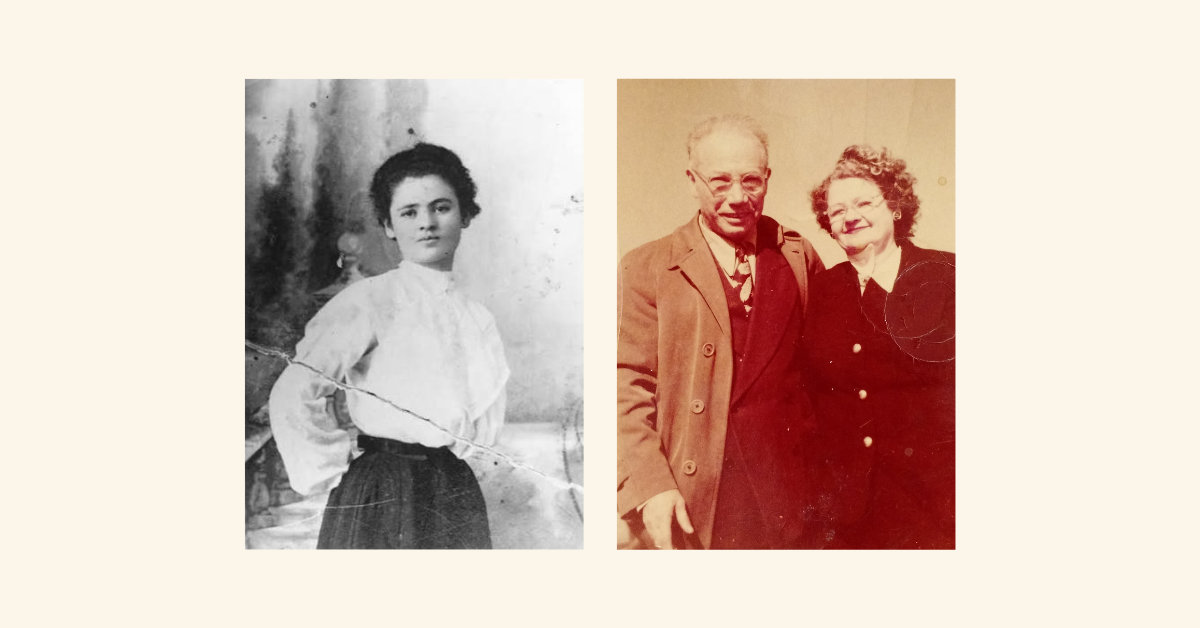
Left: Clara Lemlich in 1910; Right: Clara with her husband Joe Shavelson in 1947.
She began to organize her fellow workers and became one of the most fierce and successful union organizers in New York. She led strike after strike, even returning to her organizing after having several ribs broken by men hired by her own employer to intimidate and injure her.
And, in her most famous moment, she was lifted by others onto the stage at a large union rally led by leading labor movement figures (mostly men) and proclaimed:
“I have listened to all the speakers, and I have no further patience for talk!
I am a working girl, one of those striking against intolerable conditions. I am tired of listening to speakers who talk in generalities. What we are here for is to decide whether or not to strike.
I make a motion that we go out in a general strike!”
The general strike she pushed into existence with her words and pure force of spirit concluded nearly three months later with new contracts including better wages and reduced working hours at nearly every single garment shop.
Did that resounding success make Clara Lemlich a hero to others fighting for justice and fairness?
Absolutely not.
She was blacklisted from the broader union movement as a communist and rejected by middle and upper class suffragist leaders because of her intense focus on the needs of the working class. But nevertheless, she continued her work.
For the next fifty years, she focused on organizing working women and housewives to protest high prices and rent increases, boycott butcher shops that overpriced their goods, and oppose the use of nuclear weapons and the War in Vietnam.
Through it all, Clara never bought into the “myth of the heroic activist.” She knew that all her victories came from collaboration. That power and change came from helping others, bringing folks into one space, and moving forward together.
How Ordinary People Shape Change Together
So why am I sharing about this personal hero of mine today?
For two reasons:
For one, November 22nd marks the anniversary of Clara’s speech launching the New York shirtwaist strike. (In my calendar, it’s marked as “Clara Lemlich was a Badass Day.”)
And two: because of one more story…
When Clara was 81, she moved into an assisted living community and immediately started making a ruckus.
She talked to the leaders and residents of the building and convinced management to join in the United Farm Workers boycott of grapes and lettuce. But not done yet, she then went on to help organize the orderlies to start their own labor union.
It’s safe to say: to the managerial and upper class, Clara was a lifelong menace. 😂
But to me, she is a brilliant model of courage, of bringing people together to take action, and of centering our beliefs and dreams for what can be.
Are we all going to be as committed and consistent as Clara Lemlich? Of course not!
But each of us can see and name the problems around us. Each of us can invite others together (or join in a space that already exists.) Each of us can do something.
In her later years, Clara would frequently get questions about her life’s work. And to one interviewer, she finally said:
“Why are you here interviewing me about what I did? If you want to do something, do something.”
Right now, exactly where you are, there’s something you can do to make the world a better place for someone. And there are people waiting for an invitation to join you: in your workplace, in your family, in your neighborhood.
This week, I invite you to name a problem you've been noticing, invite someone you know cares about it into a conversation, and be open to what comes next.
📬 Share this with your people:
