How to Move Beyond The “Guilt Gap” with Small Steps and Intentional Activism
Last week, I was talking with a friend who had mailed her letters (as part of our Thank a Teacher letter-writing campaign) and she said to me, “I just wish I could do more.”
But between her job, raising kids, other volunteering she was doing, and not really knowing what would make the most impact (and of course the overarching anxiety and exhaustion so many of us are experiencing in this political moment) – she felt pretty tapped out.
She said she had the desire to do more, but a very limited amount of time and emotional energy with which to do it.
And it reminded me of the “upside-down triangle” I wrote about a few months back:
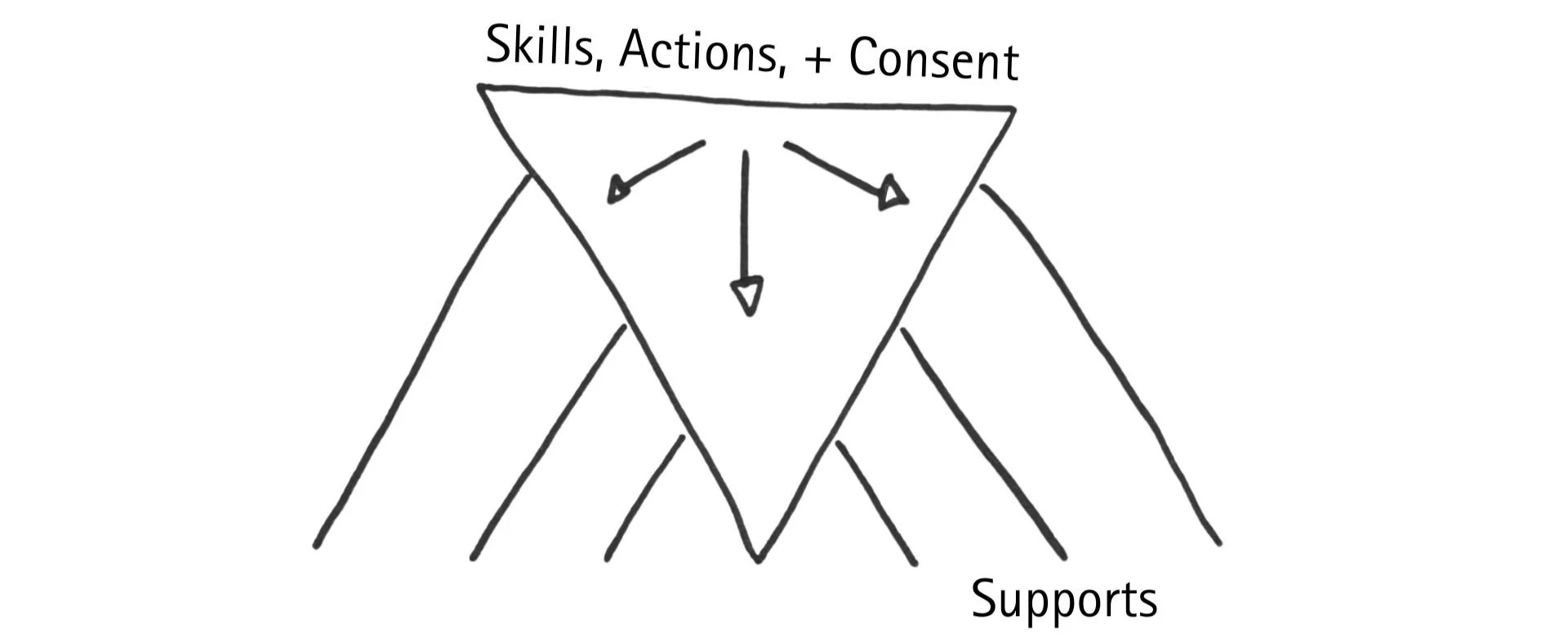
This is an image of how power moves in our society – not from some omnipotent ruler whose authority is unstoppable, but through the skills, actions, and consent of individuals, businesses, and institutions propping up the current power-holder.
This image reminds us that the power of those "at the top" is actually inherently unstable – they depend entirely on their pillars of support.
When I asked my friend what “doing more” looked like in her imagination, she immediately had a list of things: organizing mutual aid donations, inviting her friends over for group letter-writing, attending Indivisible meetings, going to protests and rallies, starting a community garden, calling her representatives everyday (and a few more I’ve forgotten).
Some of her ideas directly confronted the pillars; others worked in more indirect ways to erode the ground beneath them. But because she had so many ideas and so little time and energy, she felt stuck in the “guilt gap” between what she wanted to do and what she had capacity for.
Knowing she had loved the experience of letter-writing, I asked how she had felt when she was doing that:
“It just felt really good…and I didn’t expect that! Like I was doing something that might genuinely brighten this teacher’s day. And know that I mattered to him in that moment, even if I will probably never meet him. And to let him know that he mattered to me. It impacted me way more than I expected…and I really hope it helped him keep going.”
Burned out? No.
Overwhelmed? No.
Like she made a difference? Yes!
She had found an action that fit her current time and energy constraints, indirectly confronted the pillars by working to build a culture of gratitude rather than separation, made a likely impact on someone else, and helped her stay connected to her sense of self, dignity, and purpose.
So instead of being frozen by a long list of ways to shape change, I wondered what it might look like for her to slow down, and imagine one small action that might feel this way again – and do that. (When I asked her this, she thought about it for a few hours and then texted me that she had decided to write more letters – this time to her local representative and with her kids!)
When we look at how power moves in our society and we see the pillars at work, it can be easy to put a lot of “shoulds” on ourselves: “we should go to more marches,” “we should donate more,” “we should, should, should…”
If you’re noticing this happening or feel the “guilt gap” widening inside you, try slowing down, picking just one small thing to do that might feel for you similar to how my friend felt writing her letter, consider how it directly or indirectly makes an impact, and then tinker and try again.
Those in power are not omnipotent and permanent.
Their power is inherently unstable, maintained by pillars of support that are fragile, defensive, and within our spheres of influence.
📬 Share this with your people:
